
Leadership is the skill that eliminates barriers to successful execution by creating the conditions for people to work together effectively. Those conditions result in teamwork: a state where team members understand their roles, responsibilities, priorities, and boundaries and coordinate their actions toward shared goals.
Too many business leaders believe teamwork is something they build directly when, in reality, teamwork emerges when team members understand their role, including both their primary and secondary responsibilities, along with the boundaries and expectations that define how they operate within the team and coordinate with others.
When leadership systems are weak, teams become dependent on constant reminders, excessive meetings, and a handful of high performers who compensate for everyone else. That dependency slows decision making, creates inconsistent accountability, and makes execution increasingly unpredictable despite the team’s best efforts.
Executive Summary
- Leadership and teamwork are not separate concepts. Leadership creates the conditions that allow teamwork to occur, while teamwork is the coordinated effort that produces results.
- Effective teamwork requires systems that establish clear expectations, defined responsibilities, decision-making authority, communication standards, and accountability for execution.
- Team alignment begins when leaders are passionate about the organization’s mission, vision, and goals, and when team members share the values and purpose that support them.
- Accountability and ownership are strengthened when leaders create the right mechanics, mindset, and model for people to follow. Teams perform best when expectations are clear and people understand how their actions affect others.
- Leadership capability must exist throughout the organization. Teams become more resilient when leadership skills are developed across the team rather than concentrated in a single individual.
- The leadership skills that create effective teamwork include communication, active listening, emotional intelligence, decision-making, critical thinking, conflict resolution, constructive feedback, relationship building, storytelling, and composure.
- Teamwork is improving when communication becomes clearer, accountability becomes more consistent, problems are surfaced earlier, and execution becomes more predictable.
- In short, leadership creates the conditions for teamwork, and teamwork is the mechanism through which organizations execute their mission. Organizations that intentionally strengthen both create cultures where people do what needs to be done, when it needs to be done, with pride and precision.
Why Is Team Leadership Important for an Effective Team?

Team leadership determines whether a group of individuals becomes an effective team or simply a collection of people working in parallel. Without it, conflicts over resources, priorities, and strategy can derail even the best intentions. Effective leadership also provides the structure team members need to execute consistently and improve incrementally because, without clear systems, teams default to individual effort, informal workarounds, and constant intervention from the team leader to solve recurring problems.
Strong leadership also increases a team’s ability to adapt when conditions change. When team members understand expectations, decision rights, and how their work supports shared goals, decision making accelerates, collaboration improves, and execution becomes more predictable.
How Strong Leadership Creates Clarity
Clarity for the team is created only after the leader achieves it first. This leadership role requires a thorough understanding of what success looks like, the constraints limiting potential outcomes, the roadblocks that may derail execution, and the capabilities of the team members responsible for carrying out the plan.
In order to achieve this understanding, team leaders must work with the people closest to execution who understand the work, dependencies, and friction points leadership may not see. Effective team leadership depends on planning discussions that challenge assumptions, identify gaps, define ownership, establish decision rights, and determine how responsibilities transfer between team members when conditions change. Those discussions should answer five questions:
- What assumptions are we making?
- Where are the gaps or risks?
- Who owns each responsibility?
- Who has decision-making authority?
- How will responsibilities transfer when conditions change?
A team leader who skips this process often creates confusion instead of alignment because assumptions replace understanding. Effective team leaders recognize that leading the team effectively depends less on having every answer and more on asking the questions necessary to uncover barriers, leverage problem solving skills across the group, and create a plan the team can execute consistently.
Leaders do not create alignment by having all the answers. They create it by ensuring the right questions are answered before execution begins.
How Leadership Style Shapes Team Dynamics
Teams adopt the behaviors of their leaders. Therefore, a leader’s style shapes team dynamics because their behaviors become the behaviors teams normalize. A leader who avoids accountability teaches avoidance. A leader who withholds information creates silos. A leader who remains calm under pressure, accepts constructive criticism, and takes ownership creates a team that behaves similarly.
This happens as a result of observational learning. Psychologists have found that people tend to model behaviors that appear successful, accepted, or rewarded within the group. As General Colin Powell observed, “The most important thing I learned is that soldiers watch what their leaders do. You can give them classes and lecture them forever, but it is your personal example they will follow.” Team members pay close attention to which behaviors receive recognition, advancement, praise, and opportunity because what gets rewarded gets repeated. If leaders expect accountability, they must demonstrate it first. If leaders expect collaboration, they must foster collaboration first.
Strong leaders understand that their ability to influence team dynamics depends less on authority and more on consistency. When leaders actively listen, remain open to different perspectives, and encourage team members to challenge assumptions respectfully, trust increases, team members feel valued, and a collaborative environment develops where creative solutions surface earlier.
Leadership style is not a personality trait. It is a repeated pattern of behavior that teaches people how to operate within the team because teams rarely exceed the behavioral standards leaders model.
What Is the Relationship Between Leadership and Teamwork?

Leadership and teamwork are often discussed together because they are closely related, yet they are not the same thing. Leadership is the role responsible for creating the conditions that align the efforts of a group toward a desired future state. Teamwork is the state of coordinated effort toward a common objective. Both are essential elements of a successful team, yet each serves a different purpose.
While organizations often assign leadership responsibilities through titles and authority, the person aligning the efforts of the group is not always the formally designated leader. Most people have experienced situations where someone without authority stepped forward, provided a clear vision of the desired outcome, coordinated the team’s efforts, and helped the group move forward. Leadership occurred because someone performed the role, regardless of title.
This distinction matters because many organizations attempt to improve teamwork directly when the real opportunity lies in improving leadership. Team-building exercises, communication workshops, and trust-building activities can all provide valuable insights under the right circumstances. However, when poor teamwork stems from misaligned priorities, conflicting objectives, unclear expectations, or weak accountability, the problem is rarely teamwork itself. In those situations, team-building activities are unlikely to improve results because they do not address the root cause. Worse, they can send the message that the entire team is responsible for a problem that actually stems from how the leadership role is being performed, creating frustration, cynicism, and negatively impacting team morale rather than improving coordination, execution, and collective success.
Why Teamwork Is the Output of Leadership
Since teamwork requires coordinated effort and leadership is responsible for creating the conditions that align effort, teamwork naturally develops when the leadership role is embraced. However, the effectiveness of leadership does not determine whether teamwork exists, it influences the quality of the teamwork that emerges.
Teamwork is coordinated effort, not effort alone. Without sufficient alignment, individual efforts often compete rather than combine. This is why good people can produce disappointing results despite working hard and acting with the best intentions. Leadership creates the conditions that allow individual contributions to become coordinated effort, which is why teamwork is often one of the most visible outputs of leadership.
This relationship becomes increasingly apparent as complexity grows because every additional person, task, dependency, and constraint makes alignment more difficult to achieve without a leader. Organizations can have talented people, experienced professionals, and highly motivated employees, yet still struggle to achieve team success when their efforts are not properly aligned.
Why Good People Still Need Structure
Talented people bring their own habits, ideas, processes, experiences, and assumptions to the team. As the number of people involved increases, so does the potential for those differences to create friction. What appears obvious to one person may be completely foreign to another, while a process that worked well in one environment may create problems in a different one.
Structure reduces this friction by providing the framework necessary for individual action to combine into coordinated effort.
| Structural Element | Purpose |
|---|---|
| Shared language | Creates common understanding |
| Common priorities | Aligns effort |
| Agreed-upon goals | Defines success |
| Defined roles | Clarifies responsibilities |
| Established boundaries | Reduces conflict |
| Decision-making processes | Resolves ambiguity |
| Operational systems | Enables consistent output |
Why Effective Teamwork Requires Systems

Systems allow teamwork without being dependent on specific team members. While structure establishes the framework within which people operate, systems define how information flows, how decisions are made, how work transfers between people, and how accountability is maintained. By providing a shared method of execution, systems allow people to coordinate their actions without requiring constant direction from leadership.
| Without Systems | With Systems |
|---|---|
| Teamwork depends on specific people | Teamwork survives personnel changes |
| Knowledge resides in individuals | Knowledge resides in the system |
| Responsibilities are difficult to transfer | Responsibilities transfer more easily |
| Coordination depends on memory and judgment | Coordination follows a shared process |
| Results vary by personnel | Results become more consistent |
When responsibilities must transfer because someone is unavailable, overloaded, promoted, or replaced, a documented system provides another person a reasonable opportunity for success. Without systems, teamwork becomes dependent on the knowledge, experience, and availability of individual team members. With systems, coordinated effort can be sustained despite personnel changes.
Systems make coordination repeatable, yet coordination alone is not enough. People can coordinate their efforts efficiently and still move in the wrong direction. In order for team work to contribute to meaningful results, the best leaders will align those coordinated efforts around a shared understanding of the objective and the desired future state the organization is trying to achieve.
How Do Great Leaders Align Team Members Around Shared Goals and Company Vision?

Team alignment begins when leadership, from the Board Chair on down, is passionate about the company’s vision, mission, and goals. These individuals are often perceived as dynamic leaders because of their conviction. However, passionate leadership alone is not enough. Team members must also be predisposed to finding purpose in the mission and fulfillment in the work. Hiring for shared values and purpose is critical because people who do not believe in the destination rarely remain aligned with the journey. Additionally, the vision and goals need to be reinforced regularly. Finally, organizations need systems that monitor accountability, identify drift, and trigger early intervention before misalignment affects execution.
How Does Effective Leadership Build Accountability and Team Ownership?

Effective leadership builds accountability and team ownership by creating an environment where people understand both the process they are expected to follow and their responsibility to adapt when circumstances change. In the Radical Accountability® doctrine, accountability is the ability to follow a process and accurately explain the actions taken. Responsibility is the ability to respond appropriately to a situation based on the choices reasonably available.
The relationship between the two becomes most apparent when a plan encounters reality. As long as the process remains capable of producing the desired outcome, accountability requires adherence to that process. However, when conditions change and it becomes clear the intended outcome cannot be achieved as planned, responsibility demands adaptation. The process must be modified to reflect the new reality before execution continues. Accountability then requires adherence to the revised process and an explanation of why the change was necessary so the organization can learn from the experience and improve future execution.
This is where effective leadership becomes essential. The leader’s ability to create accountability depends on establishing the mechanics that define the process, communicating the desired end state through clear communication, and ensuring expectations are understood by everyone involved. Leaders must also foster the mindset necessary for people to understand how their actions affect customers, other team members, and the organization as a whole, enabling them to recognize when circumstances require adaptation.
Finally, leaders must model the behaviors they expect. This includes following established processes, practicing active listening, providing constructive feedback in a timely manner, and encouraging creative problem solving when reality exposes flaws in the original plan. When leaders create these conditions, not only does accountability and ownership become embedded in the culture, it sets the standards for future leaders to follow.
Why Effective Leaders Develop Leadership Skills Across the Team

Leadership creates the conditions that allow people to work together effectively. If those conditions disappear when a leader becomes unavailable, overloaded, promoted, or replaced, teamwork will inevitably degrade. Effective leaders develop leadership skills across the team to ensure those conditions persist regardless of who occupies a particular role. Organizations remain resilient when leadership capability exists throughout the team rather than being concentrated in a single person.
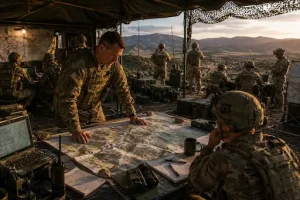
Military organizations have long recognized this reality. Every position in the chain of command has a clearly defined successor who is accountable and responsible to step into the role when necessary. This only works when potential successors possess the team leadership skills, judgment, and experience required to succeed. Capability cannot be developed at the moment it is needed. It must be developed beforehand through progressively increasing responsibility and opportunities for personal growth.
The same principle applies in business. Leaders do not build succession readiness by protecting responsibilities or remaining the sole decision maker. Instead, they intentionally develop leadership capability by creating opportunities for others to assume ownership, make decisions, and learn from outcomes. Organizations that understand how to delegate work effectively create a smoother transfer of responsibility because team members gain experience before stepping into larger roles.
This leadership approach also supports the long-term health of the organization. Without energy constantly added to a business system, it will naturally drift toward disorder. Leadership development ensures the organization continually renews its ability to maintain alignment, accountability, and execution. As leadership capability expands throughout the team, people become prepared to step into new responsibilities rather than being forced to step up unexpectedly, preserving the conditions necessary for effective teamwork.
What Leadership Skills Create Effective Teamwork?
The leadership skills that create effective teamwork are those that improve alignment, coordination, and adaptation. While the following list is not exhaustive, it represents some of the most important skills leaders use to create the conditions necessary for people to work together effectively.
| Leadership Skill | Contribution to Teamwork |
|---|---|
| Communication Skills | Create clarity around expectations, priorities, and responsibilities |
| Active Listening | Surfaces concerns, risks, and opportunities before they become barriers to execution |
| Emotional Intelligence | Helps leaders understand how decisions affect others and maintain trust during periods of uncertainty |
| Decision Making | Resolves competing priorities and keeps execution moving forward |
| Critical Thinking | Identifies root causes and evaluates alternative courses of action |
| Mediation | Resolves conflict before it damages trust or disrupts execution |
| Constructive Feedback | Reinforces desired behaviors and corrects performance issues |
| Storytelling | Connects day to day tasks to the organization’s mission and shared vision |
| Relationship Building | Strengthens cooperation between team members |
| Composure | Allows leaders to remain effective under pressure, make sound decisions, and maintain trust during uncertainty |
Different situations may require different leadership approaches. For example, an authoritarian style may be appropriate when speed, safety, or efficiency are paramount, while collaborative approaches often produce better outcomes when buy-in and problem solving are required. Effective leaders continuously develop these skills because teamwork depends on their ability to align effort, coordinate activity, and adapt when circumstances change.
How Do You Know if Teamwork is Improving?
When communication becomes clearer, accountability becomes more consistent, problems are surfaced earlier, and desired outcomes are achieved more predictably it means teamwork and team performance have improved. While key performance indicators provide evidence that results are improving, the earliest signs of successful teamwork are usually behavioral rather than financial.
Leaders should monitor both leading and lagging indicators. Leading indicators reveal whether the conditions for teamwork are strengthening, while lagging indicators confirm whether those improvements are translating into results.
| Indicator | What It Suggests |
|---|---|
| Fewer missed commitments | Accountability is improving |
| Faster issue escalation | Trust and communication are improving |
| Reduced finger-pointing | Ownership is increasing |
| Better cross-functional coordination | Alignment is improving |
| Lower turnover | Culture is strengthening |
| Improved key performance indicators | Teamwork is producing better outcomes |
What Is a Practical Leadership and Teamwork Roadmap?
Strong leadership and successful teamwork are not created by a single initiative. They are the result of leaders who consistently create the conditions for people to work together effectively. Start by building the systems that create clarity around expectations, ownership, and decision-making. Hire people who are aligned with the mission and shared vision, then reinforce that alignment by connecting day-to-day work to a meaningful purpose. Develop leadership capability throughout the organization so teamwork does not depend on a single individual. Finally, strengthen the communication, decision-making, and other soft skills that enable teams to adapt as conditions change.
As these efforts take hold, measure the signs that teamwork is improving: communicating clearer, accountability becoming consistent, and execution becoming predictable. Recognize individual strengths and place people where they can contribute most effectively to reinforce the teamwork.
The result is a culture where people willingly do what needs to be done, when it needs to be done, with pride and precision. If you want to build a team that takes ownership, executes consistently, and achieves extraordinary results, begin by examining the leadership systems, behaviors, and standards that shape teamwork every day. When your team achieves a meaningful milestone, take time to celebrate successes. Recognition boosts morale and reinforces the behaviors that make high-performing teams possible.
In short, Align. Empower. Own.