
Leading by example is the practice of demonstrating through one’s own behavior the mindset, values, and standards expected of others.
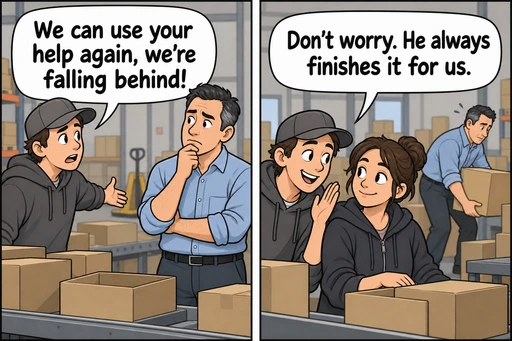
You’ve rolled up your sleeves and you’re working side by side with your team. You’re leading from the front, sharing the load, showing them you’re right there with them when the work gets hard. You know you’re demonstrating that you’re committed to their success. Meanwhile, the work only you can do is piling up. Once their day is done, you’ve got hours of work ahead making sure your own leadership responsibilities are met. Is this really what leadership is all about?
Executive Summary
Leading from the front does not mean doing your team’s work beside them. It means modeling the values, judgment, standards, and accountability you expect while creating the conditions that allow others to fulfill their own responsibilities. When your team depends on your personal involvement, growth increases your workload instead of increasing the organization’s capacity to operate without you.
Why Your Team’s Dependence on You Limits Business Growth and Scaling: Growth is not scaling when every increase in business also increases the founder’s personal workload and decision burden
What Your Team Learns When You Do Their Work: Taking over employees’ responsibilities teaches that primary obligations are negotiable and can create a culture of dependence rather than ownership.
Leading by Example: How the Model Pillar Shapes Organizational Culture: Organizational culture reflects the alignment of Mindset, Mechanics, and Model. Leaders demonstrate which values and standards actually govern through both their behavior and what they tolerate
How to Practice Leading from the Front Without Taking Over: Effective leaders create clarity, authority, resources, and decision-making capability while keeping responsibility for execution with the person who owns the work.
How Will You Lead from the Front?: Your organization is already learning from your example. Leading from the front means setting the standard and creating conditions that produce greater ownership throughout the organization rather than greater dependence on you.
Why Your Team’s Dependence on You Limits Business Growth and Scaling
When your team depends on your personal involvement to get its work done, more business means more work for you. Revenue may be growing, but so are your hours. You’ve increased what the business produces without reducing how much it needs you.
At first, that feels like success. Customers are happy, employees appreciate your support, and the numbers are moving in the right direction. You’re exhausted, but it comes with a satisfying sense of accomplishment. Sure, you postponed a few things. Once this busy period passes, you’ll catch up.
Except the next busy period arrives before you do. Strategy gets squeezed between interruptions. Decisions wait until someone reminds you they’re overdue. You answer questions during dinner and finish your work after everyone else has gone to bed. Taking a vacation means working ahead, staying available, and returning to a backlog. Soon that exhaustion is no longer satisfying. It’s just exhausting.
You wanted growth to create opportunities. Instead, every opportunity demands more of your time. Even hiring employees can leave you with more people waiting for your attention.
You want your business to scale, not simply grow. Growth still requires more of you—and how much more can you give? Scaling means growth that outpaces the increase in your personal effort. Besides, your current habits are teaching your team bad habits.
What Your Team Learns When You Do Their Work
When you treat your own responsibilities as discretionary, you teach your team that fulfilling their responsibilities is optional. That lesson reaches beyond whether employees expect you to help them finish an assignment.
Your team understands that different leadership roles carry different obligations. They know executive leaders set overall strategy and policies, VPs apply those to business units, and managers are responsible for seeing that the work gets done. When you repeatedly set aside that responsibility to join in doing the work at any level below yours, you signal that primary obligations are optional and set that as the standard.
You may believe sharing the burden demonstrates good leadership, but employees also see that you decide when the demands of your own role apply. Why should they believe their responsibilities are nonnegotiable when your behavior demonstrates otherwise?
Working late to catch up does not erase that example. It can reinforce another lesson: postponing essential responsibilities is acceptable as long as someone eventually absorbs the cost. When hourly employees follow that example, the cost can show up in overtime.
Your influence extends to leadership development. People who learn to lead by watching you may treat their leadership responsibilities as work to fit around everyone else’s tasks.
This is how an individual habit becomes team culture. Employees need not copy your specific actions to learn that responsibilities can be set aside when something else seems more pressing. Leading by example doesn’t mean doing their work; it means modeling the culture you want.
Leading by Example: How the Model Pillar Shapes Organizational Culture
Leading by example shapes organizational culture by demonstrating which values govern decisions. In Radical Accountability®, Model means “to exemplify behavioral standards.” Evaluating that example requires understanding the Mindset it should reinforce. This makes effective leadership more than a matter of leadership style.
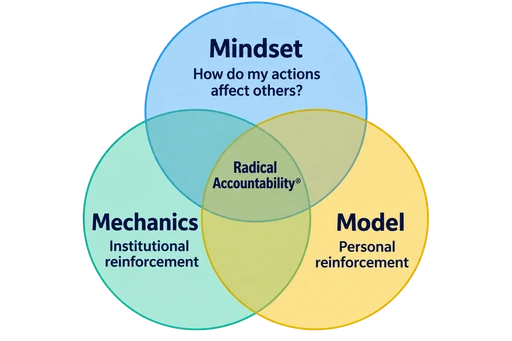
The Accountability Triad is the mutually reinforcing alignment of Mindset, Mechanics, and Model.
Mindset
Mindset is “the perspective from which people make decisions.” Values—beliefs in hierarchical order of importance—inform that perspective. In closely held private businesses, company values typically reflect the owner’s values, or a subset of them, as they apply to business.
The Mindset required for Radical Accountability considers those values while examining how decisions affect all stakeholders. When leaders face difficult situations, that consideration includes whose interests competing outcomes serve and who bears the consequences. Understanding this perspective is necessary before evaluating whether structures and behavior reinforce it.
Mechanics
Mechanics are “the structures that define how an organization functions.” They reinforce Mindset institutionally through policies, processes, procedures, training, and other structures. They establish authority, guide communication, and support the mission.
Those structures must reinforce the behaviors company values call for. If family is a company value, a policy requiring routine overtime may contradict the priority the company claims to uphold. Stating a value does little if the structures governing daily work repeatedly undermine it.
Model
Model means “to exemplify behavioral standards.” It reinforces Mindset personally through behavior. Leaders communicate priorities through how they make decisions, demonstrate respect, and fulfill their responsibilities.
Employees observe which values prevail when upholding them becomes inconvenient. They also observe what management tolerates. A leader who permits behavior contrary to company values signals that those standards are negotiable, even if their own conduct aligns.
How Does Leadership Influence Organizational Culture
Leaders influence organizational culture through how closely the structures they establish and the behaviors they demonstrate align with company values. Alignment requires Mechanics and Model to reinforce a Mindset that reflects company values and considers stakeholder effects. When personal behavior conflicts with company values, employees encounter competing expectations. The integrity issue deepens with the degree of misalignment and senior leadership’s tolerance of it.
Misalignment becomes more critical closer to the founder or C-suite, whose priorities influence the entire organization. The standard is consistently aligned behavior, requiring judgment about circumstances rather than identical responses every time.
Organizational culture takes shape through the priorities your structures reinforce and your behavior demonstrates. Leading from the front means consistently demonstrating behaviors aligned with company values and consideration for all stakeholders in every aspect of your role. That includes how you support your team without taking over their responsibilities.
How to Practice Leading from the Front Without Taking Over
Leading from the front starts with fulfilling your leadership responsibilities by creating the conditions that allow others to fulfill theirs. Effective leaders stay involved while keeping responsibility for execution with the person assigned to the work. That requires examining your own example, clarifying responsibilities, developing judgment, and practicing the accountability you expect. The following steps put that approach to organizational leadership into practice.
Identify the Behavior Your Leadership Reinforces
Examine both how your past responses contributed to a recurring problem and what your leadership requires now. Choose one situation that repeatedly draws you from managing to doing someone else’s work.
First, review the pattern:
Where have you failed to meet a commitment?
What have you done that signals, “It’s OK; I’ll bail you out”?
What have you left unaddressed that allows the problem to recur?
Then assess your response:
What responsibility belongs to the employee?
What are your responsibilities as the leader in this situation?
What other leadership responsibilities will you postpone if you take over?
What can you do now to address the problem without reinforcing dependence?
If you’ve blurred your responsibility as a leader with your team’s responsibility for getting the job done, develop a clear matrix of how to respond in the future so they see you doing your job and not theirs.
Clarify Responsibilities and Provide Resources for Success
Clarify who owns the work, what authority they have, and what resources they need to succeed. Your responsibility as a leader is to create the conditions for execution, not to become the person executing every task.
Start with the desired outcome and your vision for success, then make certain the people responsible for the work have:
Clear ownership: Define which responsibilities belong to you, the individual, and the group.
Appropriate authority: Give people enough decision-making authority to fulfill the responsibilities assigned to them.
Necessary resources: Provide the information, tools, training, people, and access required for execution.
Input into execution: Listen to the people closest to the front lines. They often see constraints you cannot see from your position and may have new ideas about how the work can be done more effectively.
Soliciting those ideas does not transfer responsibility back to you. It gives you better information for determining whether the conditions you created actually support the outcome you expect.
If the conditions are inadequate, fix the conditions. Leave ownership of the work where it belongs.
Coach Direct Reports to Develop Their Decision-Making Skills
Coach direct reports by guiding how they think through a problem without taking responsibility for the decision away from them. The goal is to strengthen their leadership skills so they can handle increasingly complex situations with greater confidence.
Use a simple sequence:
Ask for their assessment. What is happening, who is affected, and what outcome are they trying to achieve?
Ask for their options. Encourage them to generate several ideas, consider consequences, and identify the best course of action.
Challenge their reasoning. Test assumptions, expose risks they may have missed, and make certain the decision aligns with company values and objectives.
For example, during conflict resolution, resist the urge to step in and settle the dispute. Ask the employee how they would address it, what response they expect, and what they will do if that response does not occur.
This allows people to feel supported without becoming dependent on you. It also develops future leaders who can contribute to innovation instead of waiting for permission to act.
Build Accountability Through Consistent Leadership Behavior
Build accountability by demonstrating the same standards you expect your team to follow and accounting for your own actions when results fall short. Consistency between what you require and what you model helps build trust because employees can see that accountability applies to everyone.
That means:
Fulfill your responsibilities. If you expect people to meet commitments, meet yours.
Account for your actions. When something goes wrong, examine what you did, what you failed to do, and what conditions your leadership created before assigning responsibility elsewhere.
Follow the process. Do not make standards optional for yourself simply because you have greater authority.
Correct without taking over. Address failures while leaving responsibility for execution with the person who owns the work.
Consistent leadership can increase trust because people know what standard applies and see that you are subject to it as well. That consistency also creates conditions that can support employee engagement, morale, and motivation. Those outcomes are not produced by slogans or recognition programs alone. They emerge when people see that the rules, responsibilities, and expectations governing their work are applied with integrity.
That is the difference between demanding accountability and modeling it. One relies on authority. The other creates an environment in which engagement and ownership have a reason to grow.
How Will You Lead from the Front?
Leading from the front means deciding what example your organization needs from you and demonstrating it consistently. The best leaders are not the ones who personally solve the most problems. They create conditions where other people can recognize problems, make sound decisions, and take responsibility for solving them.
That matters because the people closest to the work often see problems first. Harvard Business Review reports that frontline employees spot operational friction before it becomes visible elsewhere in the organization. Your job is not to take those problems away from them, but to model the ownership and judgment you expect so people on the front lines know they are expected to raise problems, contribute ideas, and act within their authority.
Your example also affects whether people believe the standards you communicate. McKinsey found that respondents who said leaders modeled the changes expected of employees were 1.6 times more likely to report outperforming their peers. This becomes especially important during organizational change, when employees are watching what leaders do as closely as what they say.
The consequences extend beyond performance. Gallup found that 42% of employees who voluntarily left an organization believed their manager or organization could have done something to prevent their departure. Leadership behavior creates conditions that influence whether people stay, grow, and take ownership or begin looking elsewhere.
Great leaders understand that everyone else is watching. Your example teaches the rest of the organization what responsibilities matter, which standards are negotiable, and whether ownership truly belongs to the person assigned the work.
Your organization is already learning from your example. The question is whether the example you set creates greater dependence on you or greater ownership throughout the organization.
Set the standards, and demonstrate the values, judgment, and accountability you expect from others while creating the conditions that allow them to operate without you at the center of every decision. Lead from the Front.